Traffic calming pilot shows promise in Brooklyn Center
Building healthier, livable, people-centered communities is a goal across Hennepin County, but it takes a creative approach. As cities keep up with day-to-day operations, it can be hard to develop the skillset and budget to explore projects that promote walking, biking, and community health.
That’s why Hennepin County’s Active Living (HCAL) program offered funding up to $15,000 and technical assistance to support cities to take on this kind of work. "We work to sow the ground to cultivate interest in these projects," said Denise Engen, principal Active Living planner. "We grow partners' knowledge and capacity; we grow their enthusiasm to take on these projects."
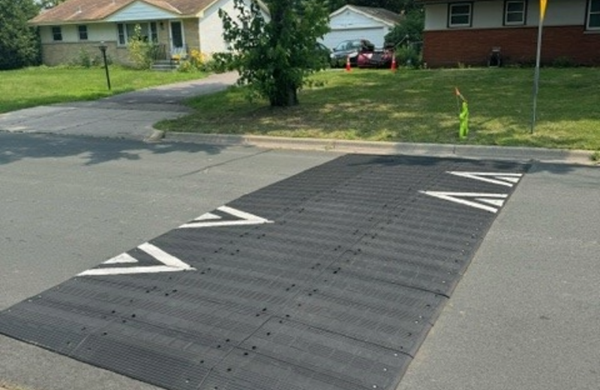
A picture of a temporary traffic-calming feature called a speed table, which was installed across a residential street during a pilot project in Brooklyn Center, MN. [photo credit: City of Brooklyn Center]
Project stemmed from residents' concerns
Kory Andersen Wagner, public works planner in Brooklyn Center, looked to this program to help the city take on new capabilities. A key goal was to acquire equipment to support the citywide traffic calming policy that Andersen Wagner hopes will speed up the cycle of feedback, testing, and traffic calming projects for the city.
A goal in that policy is to promote more walking and biking, including by addressing aggressive driving or calming corridors where people tend to drive fast. If traffic in those corridors slows down, residents will be more likely to walk and bike. "Our physical environment is designed for cars, we need to start shifting that to create opportunities to get around," said Andersen Wagner. "When there are more ways to get around, people tend to use them."
Residents of East Palmer Lake raised concerns about speeding traffic on neighborhood streets. A preliminary speed study in 2023 showed Newton Avenue had over 1,000 vehicles a day traveling down the stretch, with nearly 50 percent of drivers over the 30-mph speed limit and top speeds reaching 90 mph. This was a concerning discovery.
Successful pilot results in citywide change
The city, with support from HCAL and SHIP, in 2024 carried out a pilot project to test a variety of traffic control measures on Newton Avenue. The pilot included tools such as delineated posts, reflective tape, signage and temporary speed tables. Project results found that traffic calming on Newton Avenue reduced speeds, traffic volumes, and reckless driving on Newton without adverse impacts on neighboring streets.
Brooklyn Center Public Works used the project as a foundation for the city’s first official traffic calming program. Resulting short-term recommendations for the East Palmer Lake Neighborhood have already been implemented. After testing in more neighborhoods in 2025, adoption of a citywide speed table policy is expected in early 2026