Collaborating to conserve: our weatherization pilot
A first of its kind effort to reduce energy bills and greenhouse gasses.
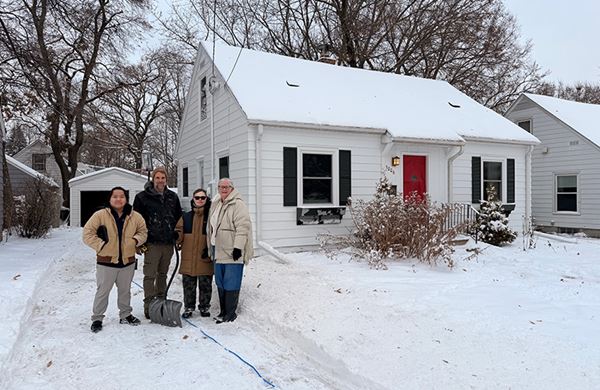
Lori Mueller, a client from our weatherization pilot project, in front of her home with her son and our weatherization contractors.
Late last year, the county’s Housing Development and Climate teams came together to complete a first-of-its kind pilot project, incorporating weatherization services into existing home health and safety projects. The pilot successfully completed seven projects and saved homeowners an average of $346.69 in total energy savings per household per year.
Weatherization work includes adding or repairing insulation, sealing air leaks, and other measures that are flagged during a home energy audit. The goal is to reduce health risks, energy bills, and greenhouse gas emissions while improving air quality and making homes more resilient and stable.
As temperatures dropped throughout the region this winter, the work came at the perfect moment to keep homeowners warmer and more comfortable in their homes.
“We’re really grateful for this work,” said homeowner Lori Mueller, who received attic and wall insulation, leak repair, and additional updates to her home through the pilot. “It’s a big improvement to our home.”
Joining forces for maximum impact
Several years of planning have culminated in this opportunity to start a pilot project to upgrade seven houses at a cost of approximately $65,000. The pilot will serve as a test case for future expansion.
The collaboration between the Housing Development and Climate teams allows already-existing home repair clients—receiving work like lead mitigation and health and safety repairs—to be identified as eligible for weatherization work.
“This collaboration builds on an already-established home health and safety program to provide even more impact for our clients, while also working toward our county-wide climate goals,” said Michael Jensen, Housing Program Manager. “It’s a win, win, win, and these projects prove that relatively small adjustments can go a long way toward saving homeowners money and benefiting our overall environment.”
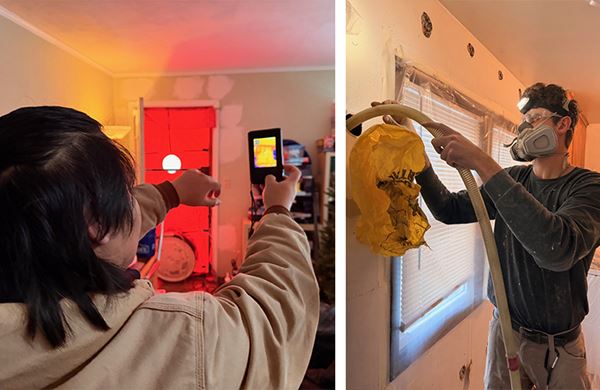
Left: Our partner at Center for Energy and Environment or Home Energy Squad using a sensor to detect cold spots in a client’s home. RIGHT: Insulation being added to a client’s walls by Franek Construction Inc.
Reducing bills, increasing efficiency
All seven of the initial households who took part in the weatherization pilot project showed significant improvements in savings after the work was completed.
Per household, families saved $207.37 in gas bills on average per month, and they saved $139.32 in electric bills on average per month, totaling $346.69 in total utility bill savings on average per month.
According to the Department of Energy, Weatherization reduces carbon dioxide emissions by an average of one metric ton per household annually, with some estimates showing reductions up to 1.5 metric tons per year.These results are just the start of what’s possible, with the potential for widespread homeowner savings and increases in energy efficiency throughout the county.
Meeting the county’s climate goals
In addition to improving a home’s value and efficiency, weatherization plays a role in contributing to the county’s climate goals of net zero carbon emissions by 2050, and 45% reductions by 2030.
This pilot project is just the start. With these initial impactful results in hand, we hope to expand and continue the program, reaching many more homes to come.